Tuesday, September 10, 2019

Side #2 - Museum and Concrete

Once you park your car, or get off the tour bus at the city of Side, this is the best place to start your visit - at Side's Historical Museum - one of my very favorites.
The Archaeological Museum of Side - courtyard. 

This is a wonderful site - unlike any museum I've ever visited... relaxing, beautiful and aesthetic. Trees, grass and benches provide relief from the hot Mediterranean sun. You also get a great view to the southwest from the museum...
...toward Antalya. Many of the mountains in the low-lying mountain range (darker blue) form the backdrop for Aspendos, a Roman city I found to be rather intriguing. Here's my page on that wonderful city.


Museum Courtyard
https://turkisharchaeonews.net/museum/archaeological-museum-side
Above, an odd assortment of carved stones in the courtyard. The museum is located in an old Roman Bath building which overlooks the beach. It's just a short walk to the Roman Amphitheater and city gate, Vespasianos Aniti.

https://www.turkeycentral.com/gallery/image/8602-entrance-side-museum/
Entrance to the Side Museum. (above) Note the large buttress on the left side made of concrete blocks which was once a wall for the Roman baths.
Cliff_Emerson
Cliff_Emerson
Large concrete blocks. (After reading the sign: I'm hardly worried about things collapsing! They're not going to crumble! They're made of Roman concrete.)

Roman engineering was extremely advanced, and concrete was one of their amazing specialties.
Cliff_Emerson

It enabled them to build fascinating structures around the Roman world that are still standing today: the Colosseum, baths, aqueducts, theaters, race tracks, walls and even the Pantheon. Let's visit the Pantheon in Rome for a few minutes.
https://www.dailymail.co.uk/sciencetech/article-2021133/Pantheon-Rome-actually-giant-sundial.html
Pantheon:
The Pantheon in Rome is a massive concrete building capped by an impressive 142-foot-high concrete dome—the largest in the ancient world.

Made entirely out of concrete, without the reinforcing support of structural steel, no modern engineer would dare attempt such a feat, says David Moore, author of The Roman Pantheon: The Triumph of Concrete. “Modern codes of engineering practice would not permit such mischief.”

And yet for nearly 2,000 years the Pantheon has withstood weather, earthquakes, and attacks from Barbarian invaders.

"...most of the bricks were produced and placed in the Pantheon in 123 A.D., a date that the manufacturer stamped on his bricks. This was discovered in 1892 by the French archaeologist, George Chedanne. It appears the construction of the rotunda walls took a period of 4 to 5 years to "mature" - pozzolan concrete needed ample time to develop strength."
http://www.romanconcrete.com/docs/chapt01/chapt01.html
https://www.dailymail.co.uk/sciencetech/article-2021133/Pantheon-Rome-actually-giant-sundial.html
I've spent a lot of time looking at Roman concrete in various locations across Europe and Turkey, and find the material quite amazing - even captivating.
There are many of tons of concrete in the entire structure of the Pantheon.  "The 4,535-tonne weight of the Roman concrete dome is concentrated on a ring of voussoirs 9.1 metres (30 ft) in diameter that form the oculus (round, center hole). The downward thrust of the dome is carried by eight barrel vaults in the 6.4-metre-thick (21 ft) drum wall into eight piers." 
(https://en.wikipedia.org/wiki/Pantheon,_Rome)

"History contains many references to ancient concrete, including in the writings of the famous Roman scholar Pliny the Elder, who lived in the 1st century A.D. and died in the eruption of Mt. Vesuvius in A.D. 79. Pliny wrote that the best maritime concrete was made from volcanic ash found in regions around the Gulf of Naples, especially from near the modern-day town of Pozzuoli. Its virtues became so well-known that ash with similar mineral characteristics–no matter where it was found in the world–has been dubbed pozzolan.

Pantheon
An international team of researchers was able to discover the “secret” to Roman cement’s durability and longevity by analyzing the mineral components of the cement taken from the Pozzuoli Bay breakwater at special laboratories. The Roman engineer Marcus Vitruvius recorded how to make concrete in 30 BCE.
cliff_emerson
Amphitheater at Side - made of large stones and cement
cliff_emerson
The back side of the amphitheater at Side

The special formula of Roman concrete called for a concoction of volcanic ash, lime, and seawater, mixed together with volcanic rocks and spread into wooden molds that were then immersed in sea water. This is where they got the volcanic ash! Researchers have studied drilled core samples of the ground structure at Pozzuoli Bay near Naples, Italy to obtain this volcanic ash.

https://www.youtube.com/watch?v=dbvvlFHCNn4
Why was Roman Concrete Forgotten during the Middle Ages?

The seawater triggers a chemical reaction, through which water molecules hydrated the lime and react with the ash to connect everything together. The resulting bond:
calcium-aluminum-silicate-hydrate (Ca-Al-Si-H) 
is exceptionally strong. When analyzed, they found that the seawater had dissolved and solidified components of the volcanic ash. For example: The harbor located in Caesarea, shown below under construction, is made of this concrete.
https://www.history.com/news/the-secrets-of-ancient-roman-concrete


https://i1.wp.com/thelampstand.com.au/wp-content/uploads/2018/02/6.1-Roman-Conmcrete.jpg?ssl=1
Our inferior modern concrete (usually called "Portland cement") - is used in everything from roads to buildings to bridges and can break down in as few as 50 years.


LINK to a video: 
"The Roman period's main harbour of Ancient Corinth Discovered"(2:35 min.)

http://www.soniahalliday.com/category-view3.php?pri=TR111-12-07.jpg
Another example: The Roman mole at Assos, Turkey - site from which Paul sailed on his Third Missionary Journey.

In conclusion, the Romans invented an advanced process for creating "moles"
or underwater walls using poured concrete right into sea water where it hardens.
By NASA - NASA, Public Domain, https://commons.wikimedia.org/w/index.php?curid=959854
Above, the harbor of Pozzuoli in center of picture is located south of Naples. Notice the abundance of craters, which indicate volcanic activity - in fact, there is a huge amount of seismic activity in the Naples area, especially from nearby Mount Vesuvius.

NOTE: I've been to the village of Pozzuoli, and walked down into a depression with hot, stinking, sulfur pots. "Fooey!" Paul came ashore here on his trip to Rome after being ship-wrecked on Malta. 

In contrast, the Greeks didn't use concrete, but fit their stones together very precisely - something I'll show you in pictures from walls at Assos and Didymus, ruins also in western Turkey.

We'll leave my obsession with concrete now, and get back to the museum at Side...
http://www.romeartlover.it/Side5.html
Many fine marble works of antiquity recovered locally from the Side city are now located inside the Roman Bath building.
https://www.turkeycentral.com/gallery/image/8619-sarcophagus-room-side-museum/
The "Sarcophagus Room."
https://www.turkeycentral.com/gallery/image/8619-sarcophagus-room-side-museum/

https://www.turkeycentral.com/gallery/image/8619-sarcophagus-room-side-museum/
cliff_emerson
cliff_emerson
A lion's head from the Sarcophagus above
cliff_emerson


cliff_emerson
cliff_emerson
Fragments found on-site.
Cliff_Emerson
Back outside to the museum's courtyard; a gladiator fight is currently being displayed - portrayed on a stone column. Study this picture carefully. This is the most intriguing piece of Roman sculpture I've ever seen - both figures seem to be in motion - with sufficient equipment detail, posture and pathos to help you imagine the intensity and feel the proximity to the combat. 
Cliff_Emerson
Here's that same pillar.
cliff_emerson
Above, the scene on the left side shows one warrior who was able to defeat and kill another, most likely in a coliseum similar to the one in Rome.
Cliff_Emerson
I love articulate stonework from antiquity, and this museum certainly has some wonderful pieces.
cliff_emerson
cliff_emerson
This appears to be a child's sarcophagus with a lid. Perhaps the child was from a rich family who could afford such a masterpiece.
cliff_emerson
The carving above shows some act of servitude. (It reminds me of the shoe-shiners I used to see in Chicago's O'Hare airport when I was on business trips!)
Cliff_Emerson
This piece looks like part of a freeze from a building. The figure on the left seems to represent half of the ancient Greek theme of Tragedy (and Comedy) in theater. The one on the right is indifferent.
Cliff_Emerson

Click here to access the Table of Contents

Friday, January 6, 2017

Visit to Side #1

What an incredible Roman city! I had a great visit here.
Wikipedia

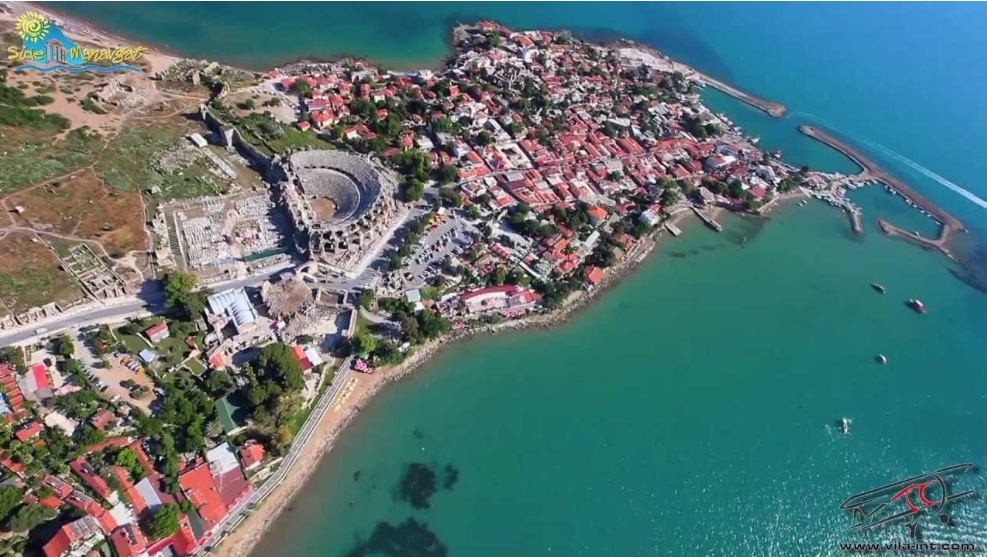
The ancient city of Side /see-day/ on Turkey's southern (Mediterranean) coast is a well-known touristic site. It lies near the modern city of Manavgat, 78 km east of Antalya, which is a well-frequented holiday site on the coast. Many Europeans, and especially Germans, come here.

Side was settled by Greek colonists from Aeolia, (near Smyrna, now modern Izmir) in the 7th c. BC, according to the classical Greek geographer, Strabo (63 - 23 BC).

Side is so picturesque. What a terrific location for a holiday! Beaches, float-trips on a river, shopping, wandering through town. Many people come for the beaches and night-life (not my thing!). Or, if you're interested primarily in the history (like I am) there's a lot to explore that is left over from the Roman and Byzantine periods.

https://blog.padi.com/2018/07/01/diving-side-turkey/

Below: Take a couple minutes to enjoy the city from above in this fantastic 360-degree aerial video. (Be sure to expand it for a better view.)
Side's natural geographical setting and protective harbor made it one of the most important trade centers in the eastern Mediterranean region during the period of the Roman Empire.
Wikipedia
As part of a day-trip, Side was about 1-1/2 hours from Antalya by car - not such a long distance, but slow-going on a crowded highway with many stoplights and crazy drivers. It was well worth the time, however. (You should know that driving in Turkey is challenging, and sometimes dangerous. I'll cover that topic later.)
The harbor of Side. Side is located near the mouth of the Manavgat River. After visiting the ancient city, you can drive a few km. to the east, and locate the docks where you board a special ship that takes you upstream for the day.
https://www.viator.com/tours/Side/Manavgat-River-Cruise-with-Grand-Bazaar-from-Side/d23557-9398P29
The boats travel all the way up to a set of waterfalls.
(see video:  https://vimeo.com/183093005).
https://yukitour.com/tours/rafting-manavgat-river-tour/
The Dumanli Spring source is actually below water level of the reservoir that covers the valley today.
"At an elevation of 1,350 meters, the outflow of several small springs joins together to become the headwaters of the
Manavgat. The largest of these springs is called Dumanli, whose name means "place where there is fog", because of the dense mist that forms above the spring (most probably when its water temperature is cooler than the air temperature).

In addition to the springs from the Taurus Mountains, the Manavgat River is also fed underground from large lakes to the north of the mountains, on the Anatolian Plateau. (Wikipedia)
https://www.lonelyplanet.com/turkey/activities/manavgat-boat-trip-waterfall-bazaar/a/pa-act/v-114189P15/360857

https://www.alaturka.info/de/tuerkei/tuerkische-riviera/side-manavgat/367-manavgat-fluss-melas

Here is more information about the river.

The Manavgat
 River empties into the Mediterranean on the right side of this picture. Side's peninsula is located on the left side.


A Roman road went up the same valley northward through the Taurus Mountains and across the plains to Iconium - Book of Acts - now modern-day Konya, another important Roman city.

https://turkisharchaeonews.net/object/aqueduct-and-nymphaion-side

The nymphaion - the site for the reception of water from an aqueduct - is located on the west end of the present excavations when you drive into the area. It's a combination of marble columns and stone blocks.

https://blog.padi.com/2018/07/01/diving-side-turkey/
Side is built on a peninsula 1 km. long and roughly 400 meters wide. Above, beyond the amphitheater, which was built in the  style of most Greek structures - on a hillside, notice the two harbors, the rectilinear street pattern from the Romans.

Walking through the city, itself, is not especially complicated because of it's rectilinear by nature, and a few structures - like bath buildings - remain standing and can be visited.

Above, the large patch of dark-green and dark-brown land between the coasts is included inside the city's walls and is likely part of the necropolis, but has comparatively little to offer in terms of archaeological or touristic interest, except for a hospital building from the Byzantine period. Most of the sarcophagi are on display in the city's museum.


According to Arrian (Lucius Flavius Arrianus - Greek politician and historian,85–90 to 145/146), settlers who came to Side abandoned their native Greek language and began using the language of Side. The name "Side" originates from this language, and means "pomegranate." It can be found stamped on coins minted from roughly 500 BC to the Roman Imperial period. [Street vendors here sell glasses of freshly pressed pomegranate juice, by the way.]

Several non-Latin and non-Greek inscriptions dating from the 3rd - 2nd centuries BC found in the area remain undeciphered. A basaltic column base also found in the excavations from the 7th century BC are attributed to the Neo-Hittites.

Alexander the Great captured the city in 333 BC on his way to Persia, and the inhabitants put up no resistance. He left troops stationed there.

Side became an important city in the slave trade, beginning in the Roman period.

Below, an over-sized painting of how Side looked during the period of its greatest development as a Roman city. Note the elaborate aqueduct system - at the top and bottom - which was fed through springs in the Manavgat River. Aqueducts - like so many other Roman sites in the Western World and Middle East - were quarried for their stone, which was used at other building sites in the centuries following the fall of the Roman Empire.

Be sure to scroll the picture below horizontally!
In 25 BC Side became part of the Roman province Galatia and prospered through its trade in olive oil and slaves.
  
After the Roman senate established Asia as a province in 129 BE, Side was the most distant city from the provincial capital Pergamum, located on the west coast of Turkey near the Dardanelles. To link the cities, M. Aquillius built a road between them in 129-126 BCE. Below is a typical example of a Roman Road - this one located north of Tarsus, Turkey.
https://www.megalithic.co.uk/modules.php?op=modload&name=a312&file=index&do=showpic&pid=84430
During the second to the first century BCE, Side became a haven for pirates who used its harbor as a dockyard and its slave markets to auction their prisoners, Side became rich under the Romans and was always a rival of Perga.

The city was burned by Arab raiders in the 7th AD century, within decades of the death of Mohammed (632 BC).

Today, Side is an attractive coastal city, combining antiquity, modern Turkish culture and shopping, beaches, hotels and real estate.

https://www.holidaycheck.de/hi/crystal-sunrise-queen-luxury-resort-spa/16370210-1bc3-3fc6-b029-28843070e99aCrystal 

Sunrise Queen Luxury Resort & Spa
As a resort town, Side is one of the best-known touristic centers on the south coast of Turkey.
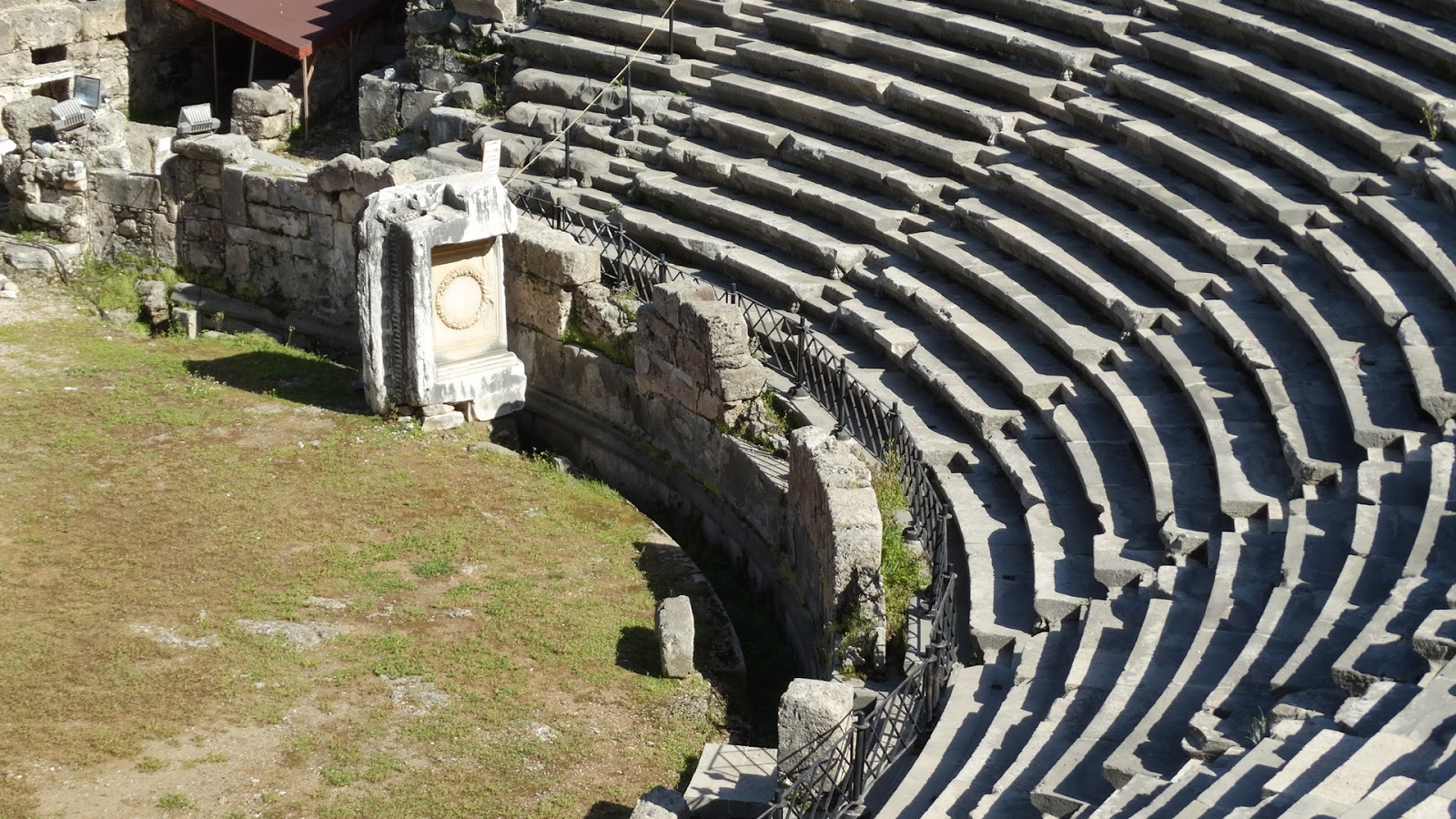
Side's theater is the largest in southern Turkey, and was built on top of a Hellenistic structure from the 2nd century. It seated 17,000 people. The city lacked a sloped hillside that could be hollowed out in the usual Greek fashion, so large Roman-style self-supporting, arched walls were used, with 29 rows above and below the main horizontal level. It's a joy to visit this structure.
http://resources.touropia.com/gfx/d/ancient-theatres-of-greek-roman-antiquity/theatre_of_side.jpg
It is well-preserved - similar to the theater at nearby Aspendos LINK. 
http://static.panoramio.com/photos/large/89630900.jpg
According to Mark Wilson, a high wall was constructed on the floor level around the perimeter to protect spectators during gladiatorial and wild animal fights.
Cliff_Emerson
Cliff_Emerson
Above, a view straight north, toward the coastal mountains. Below, notice the variety of displaced, miscellaneous stones stacked in the front of the theater, near the stage area.
Cliff_Emerson
Cliff_Emerson
Below, an artist's reconstruction (scanned from guidebook I purchased on-site) of what the theater stage structure probably looked like in its completed form.

Cliff_Emerson
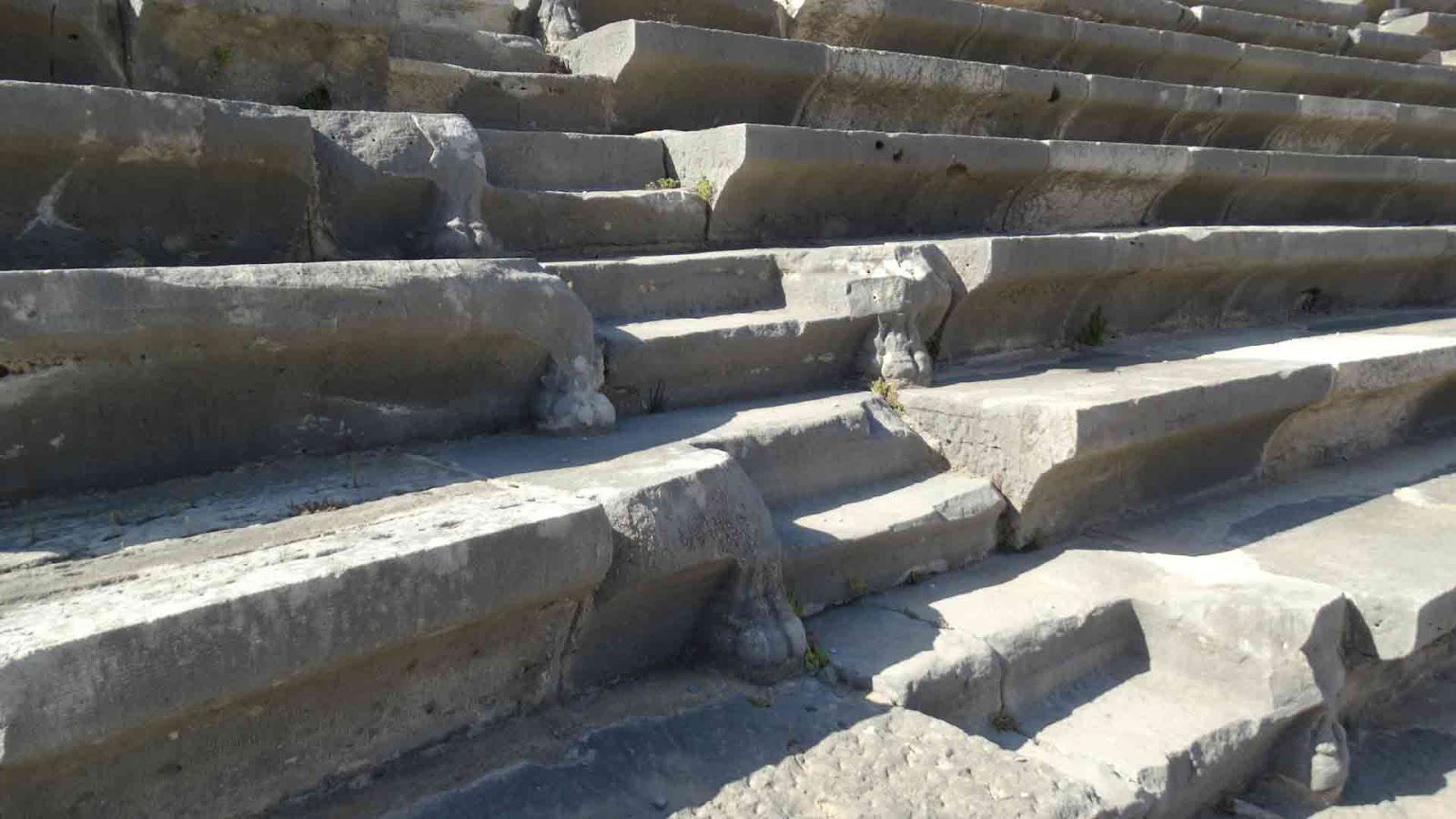
Above, steps and row-seats reflect high-quality stonework with quite attractive ornamental lions' claws, demonstrate the well-preserved nature of the theater. (I've seen these same lion claws in the amphitheater in Melitus (western coast of Turkey), by the way.) The horizontal lines below show prior wind-blown sediment which was cleaned-out.
Cliff_Emerson
Cliff_Emerson
Above, advanced barrel vaults fit the archway and other walls of the portals together.
Cliff_Emerson
 Below, shots of the back side of the theater.
Cliff_Emerson
Cliff_Emerson
South side. Many stones were removed to use on building projects elsewhere.
https://www.propertyturkey.com/blog-turkey/6-reasons-we-love-side-turkey
The entire ancient city site measures about 112 acres, and dates from the 1-4 centuries AD. A visitor should plan to spend at least a day, including at least 1 hour in the historical museum, which I found delightful. Here's a worthwhile video. Click on it to enlarge it:
Side - Turkey
https://www.youtube.com/watch?v=9B7uTVhm1Y0

The city was divided into four quarters in antiquity: Great Gate, Great Guild, Altar of Zeus, and Quadriga, based on inscriptions that refer to major monuments in each area.

On your walking tour, you could follow a circuit that passes the outer gates, / nymphaeum, along the columned streets, to the theater and museum (agora bath).
This aerial view looks NW. Notice the Roman road that passes through a monumental arch (center, left), which probably had a quadriga, or chariot, with four horses on the top. It is similar to the quadriga you see in Berlin at the Brandenburg Gate LINK and Venice's St. Mark's Basilica façade.  LINK


http://e-turkeytravel.com/wp-content/uploads/2016/07/Side-Turkey.jpg
Above, an aerial view of the temple grounds and mole (underwater harbor made of rocks and poured concrete) remains of the ancient harbor, a meeting place for pirates and natural shipyards.

(Click here to navigate with the second post in this series:  "Visit to Side #2 - Museum")

Click here to return the Table of Contents for this website.

+++++++

Excellent Guide that I used during my trips in Turkey: (available on Amazon - LINK )

1 Wilson, Mark. Biblical Turkey - A Guide to the Jewish and Christian Sites of Asia Minor, page 123, Yaylinlari, 2010/2014.   ISBN-13: 978-6057673299

Featured Post

Hittites in Turkey #3 - Bogazköy

  wikipedia Hittite cuneiform tablets from Bogazköy  https://www.hethport.uni-wuerzburg.de/HPM/hpm-en.php?p=general-en The only existing col...